
Theory Behind Listening Touch
Listening Touch is a couple’s modality designed to teach better nonverbal communication skills in pursuit of a pretty simple goal: learning how to stay regulated during disagreement, conflict, and high emotionality so that you can have more productive conversations.
What does it look like? Self-regulation through conscious breathing, then inviting a couple to initiate slow, mindful touch with one another —often with as little as the tip of a finger against their partner’s— and beginning to explore how to communicate with that touch.
Once the language is established and a couple learn how to negotiate nonverbally and pay attention to how regulated the other is, then we begin having a verbal process about any content the couple is bringing to therapy. Touch then becomes a real time feedback tool about how regulated either member of the couple is, as well as an effective method (perhaps the most effective method!) of reestablishing coregulation.
Counseling Theory, Biopsychology, and Attachment!
First and foremost, Listening Touch is built on the back of contemporary science, including both the “hard” science of biology and the “soft” science of counseling theory.
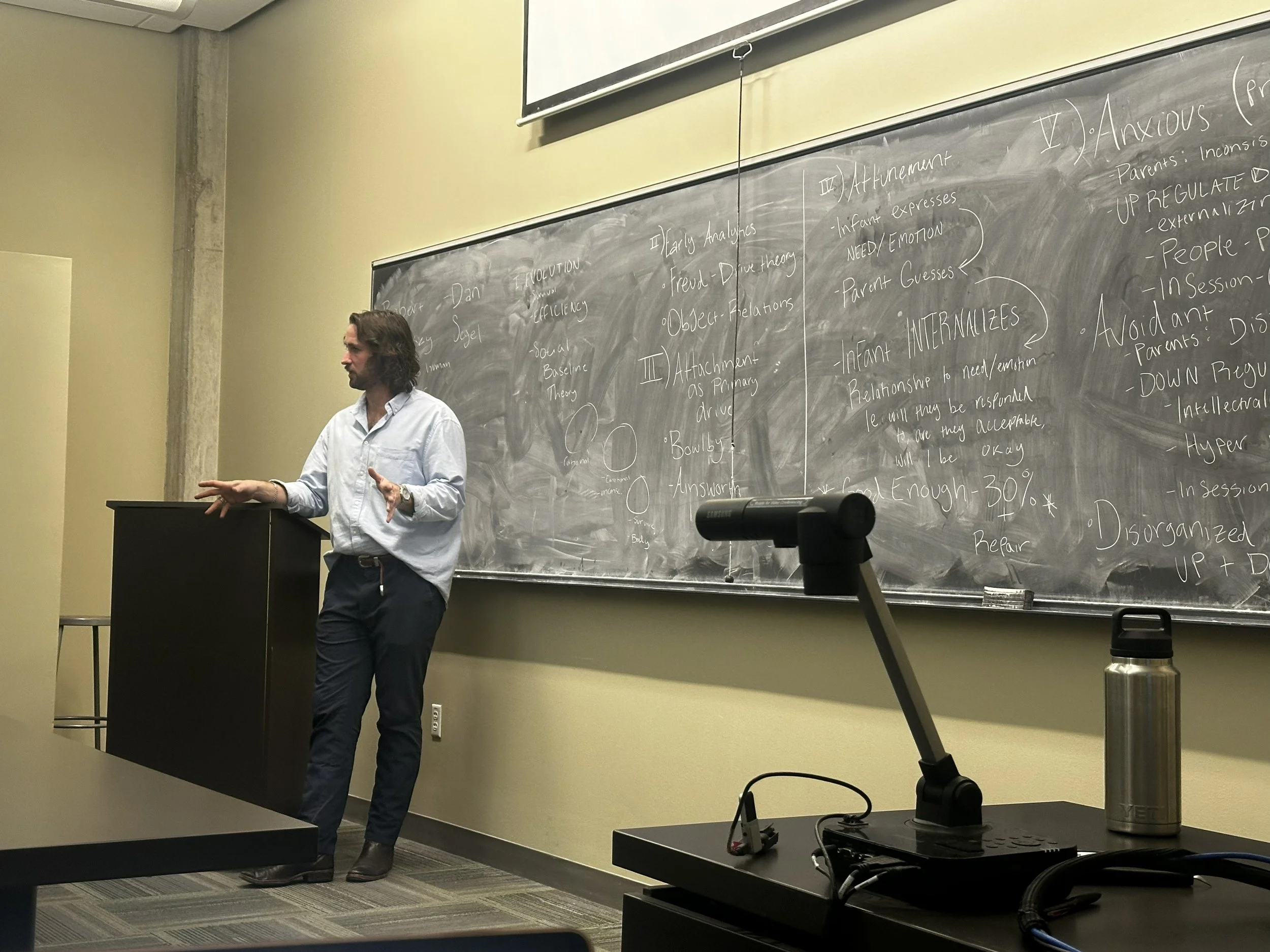
Most of LT’s theoretical dna originates in PACT, Stan Tatkin’s work. PACT is rooted in Tatkin’s understanding of the human attachment system and how securely interdependent relationships function on a moment-to-moment basis. PACT therapy is designed to teach couples how to attune to each other (guess how the other is feeling) through structured pauses and mindfulness during the verbal process.
And as I keep saying: when something important is happening, the verbal process goes out the window! It may not be the best tool to lean on if our goal is to teach body to body (nervous system to nervous system) regulation.
Of course, when discussing any Attachment oriented therapy we owe credit to psychoanalysis for codifying the idea that early experiences affect how adults think and feel, and that thinking and feeling exist in different parts of the consciousness. Listening Touch as a therapeutic modality leans on analysis in its assumption that two bodies/nervous systems/unconsciouses begin communicating the moment two humans meet, and that as we attempt to pay attention to that communication and make it conscious that stories and feelings and Attachment patterns will reveal themselves.
Virginia Satir and Carl Whitaker, both pioneers in Experiential Family Therapy, used their own very human presence to help reveal those same stories and patterns. Psychodrama, Family Sculpting, Interactional Sequencing, Therapy of the Absurd, all influences on this body of work. LT simply goes a little closer to the source – the body itself.
LT is also rooted in biopsychology, the study of how the brain and body interact to form the whole of the subjective human experience. I studied biopsych in school, and the bulk of my current understanding comes from the lectures of Robert Sapolsky. Bridging the gap between biopsych and therapy is Tori Olds, PhD, a clinician from whom I have learned a ton.
Bodies!
The other main philosophical influences on Listening Touch are Eastern and indigenous, feminist, dehierarchal worldviews.
Listening Touch is rooted in admiration of the intelligence of the animal bodies we occupy as humans. Always, LT exists in acknowledgement of human consciousness’s place in the Family of Things.
Listening Touch is also, practically speaking, a mindfulness practice! In her video about the History of Experiential therapy, Dr. Olds discusses how mindfulness (and Attachment science) fundamentally shifted our approach to modern therapy.
LT also pulls from Tantric philosophies and practices. Traditional Tantra is the practice of engaging with the present moment through breath, sound, and movement. Sexual practices are a part of traditional Tantra, but a small part, unlike in western neo-Tantra.
Perhaps the most influential practice behind Listening Touch is Contact Improvisation, a school of dance instigated in the 70s by a dancer named Steve Paxton.
Contact Improv!
Contact improv is oriented around paying very close attention to a point of physical or nonphysical contact between you and another person, engaging in deep listening touch before ever exploring movement. One of Steve’s partners, Nancy Stark Smith, deepened CI’s philosophy around non-sexual, non-combative touch as a form of conversation between multiple bodies.
As I stuck around CI classes, I noticed that people would come in with no touch language, no defined attunement skills, sometimes little sense of embodiment, often with no dance experience at all, and within a span of months they would develop the ability to have fluent, expressive nonverbal conversations with total strangers.
Think about that! A person who comes in off the street who never touches strangers, who perhaps doesn’t even touch another person on most days, then becomes comfortable with non-sexual physical intimacy to the point that they can develop whole relationships with others in the same way they would walking into a mixer or happy hour or party, just without saying a word. That’s an amazing tool!
And of course I thought:
That’s what we’re trying to get couples to do!
If You Can’t Dance, You Can’t Talk!
As I deepened my own dance practice, I began to find myself in friendships and romantic relationships with other dancers, and I started to see how beautiful it was to have a shared movement and touch practice. Then I started to pay attention to what it was like to have dialogue about our relationship while we were dancing.
And I noticed that when the verbal process got elevated, the dance would speed up, or stop completely, or become subtly combative.
So I started playing with the question of “what happens if I prioritize the dance over the verbal process”? What happens if the conversation doesn't continue until the dance can continue?
Because in order for the dance to continue, I need to be curious, I need to listen, I need to breathe, I need to slow down.
And I realized something kind of interesting – The conditions under which I can dance are also the conditions under which I can have productive conversations about difficult things.
Wow! Cool! Now we have a feedback tool that we can use anytime! Those are really rare in couple’s therapy!
If you can’t maintain a curious, Listening Touch, then you can’t talk. It’s that simple.
Listening Touch
So first, I get couples to the point where they can maintain a listening, curious touch, and immediately, stuff comes up!
We have stories about touch, about initiating touch, about what kind of touch, about what is going to happen next if I get touched there, about saying no, about hearing no, there’s always content about touch! And of course there is! Physical intimacy is a huge chunk of a romantic partnership but most people don’t have great language for talking about it, and often it’s too activating and laden a subject to talk about productively.
So first we get to a place where touch becomes an accessible language and tool, where a couple can remain present and curious and coregulated (not calm! regulated does not mean calm! more like “emotionally capable”!), or they can step back and use movement to self-regulate if they cannot. Then we bring in the content! Who is or isn’t doing the dishes, or whatever.
And as couples move together and touch as they discuss content, the interactional sequence begins to reveal itself. Someone pulls away, someone chases, someone shuts down, someone goes rational. All of those defenses show up in the movement and touch between the partners! What happens big happens small.
And so we get to the core of the interactional sequence much more quickly and much more honestly. And now a couple has something they can actually use outside of session!
If you can’t Listen, you can’t talk.
Find each other first.
Then keep going.